

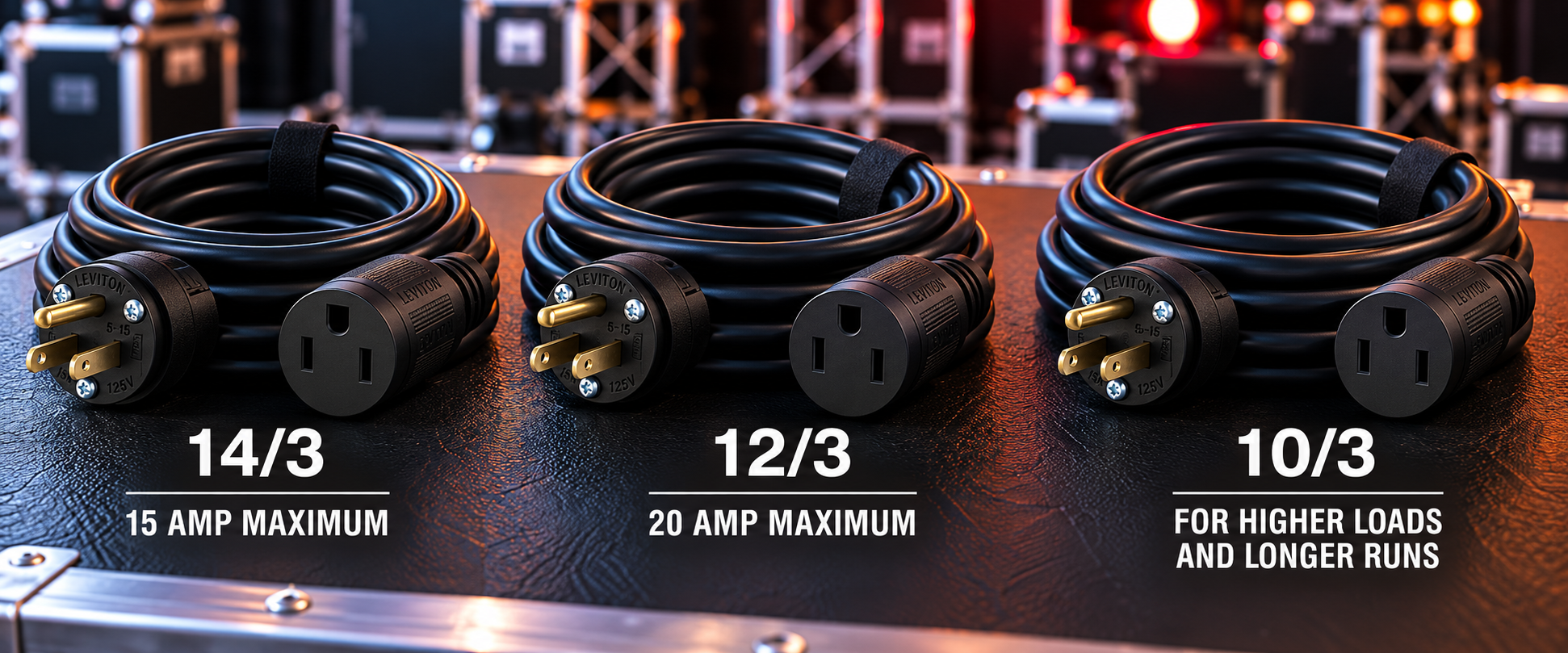
Choosing a power cable isn’t just about finding one long enough to reach. The amount of current you need and the length of the cable both matter.
Start With the Load
For common copper power cables:
- 14/3 — Maximum 15 amps
- 12/3 — Maximum 20 amps
- 10/3 — A heavier conductor for higher-current or longer runs
The cable is only one part of the system. The circuit breaker, receptacles, plugs, connectors and equipment must also be properly rated for the application.
Length Matters Too
Every foot of cable adds electrical resistance. The longer the run and the greater the current, the more voltage is lost along the way. Using a larger conductor can substantially reduce that drop.
Voltage at the Equipment — 120V Source / 15A Load
Approximate voltage by cable length
Values are approximate for a 120V source and 15A load. Actual voltage can vary based on the source, total load, connections and other factors.
A Real-World Example
We see this regularly in live-event work. At venues where several long extension cables have been used between the building and the equipment, we have measured incoming voltage as low as 107–108 volts.
That doesn’t necessarily mean one particular extension cable caused the entire drop—the building wiring, circuit load, connections and multiple cables can all contribute. But it demonstrates why voltage at the equipment can be very different from the voltage at the receptacle where the run began.
Low voltage can affect the operation of amplifiers, powered speakers, lighting, computers and other electronic equipment.
A Simple Rule
Use the shortest practical cable and choose the wire gauge based on both the load and total cable length.
For many typical 15A applications, 14/3 is appropriate. As the distance or load increases, moving to 12/3 or 10/3 can substantially reduce voltage drop.
14/3 cable should never be used for a load exceeding 15 amps. When in doubt, choose the heavier cable.
Ready to Choose Your Power Cable?
Wild Willie’s power cables are hand-built for professional use with genuine components and are electrically tested before shipping.
