

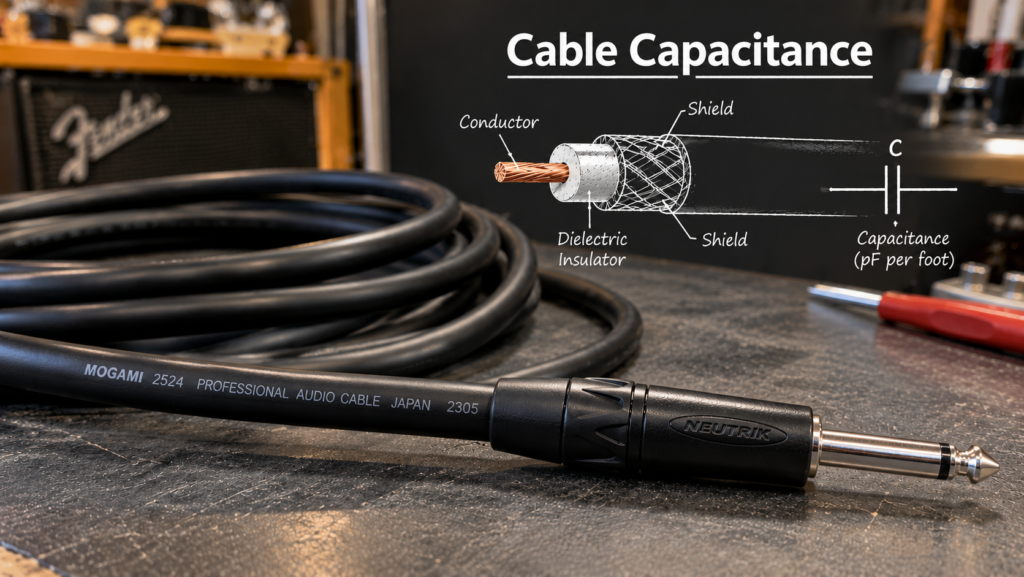
You’ve probably heard claims that expensive audio cables deliver better sound, greater clarity, or improved frequency response. Some claims are exaggerated, but there are real electrical differences between cables worth understanding. One is capacitance.
What Is Cable Capacitance?
Every audio cable has capacitance. It is a natural electrical characteristic created by conductors separated by insulating material. Capacitance is measured in picofarads (pF), usually expressed per foot or meter of cable. The longer the cable, the greater its total capacitance—and depending on what you’re connecting, that can affect the sound.
Why Guitar Players Should Care
Passive electric guitar and bass pickups are particularly sensitive to cable capacitance. The pickup, cable, and amplifier input form an electrical circuit. Increasing capacitance changes its frequency response and can make an instrument sound darker or less bright.
For example, with a hypothetical cable rated at 40 pF per foot, a 10-foot cable contributes about 400 pF while a 25-foot cable contributes about 1,000 pF. That’s two and a half times as much capacitance simply because the cable is longer. The audible effect depends on the pickups, controls, amplifier, and other equipment in the signal path.
What About Microphone Cables?
Most professional microphones use balanced, relatively low-impedance connections. These are much less sensitive to cable capacitance than passive guitars. With properly designed professional equipment, a typical 25- or 50-foot balanced XLR microphone cable is unlikely to suffer meaningful audible high-frequency loss from capacitance alone.
For everyday live sound, shielding, flexibility, durability, proper construction, and reliable connections are generally more important than chasing the lowest capacitance number. Extremely long runs and unusual equipment combinations can change that calculation.
Is Lower Capacitance Always Better?
Not necessarily. Instrument, microphone, and speaker cables have different electrical and mechanical requirements. Some guitar players even prefer the warmer response associated with higher cable capacitance. The goal is to understand the application and choose the appropriate cable.
Why We Choose Quality Cable
At Wild Willie’s Cables, we choose professional cable with consistent, documented electrical characteristics and dependable construction. For our instrument cables, we use Mogami W2524 for its electrical performance, flexibility, and durability.
Read more in our companion article: Why We Build Our Instrument Cables with Mogami W2524.
A good audio cable shouldn’t promise magical improvements to your sound. It should deliver the signal reliably, with the appropriate electrical characteristics for the job.
